
A glass jar closure does more than hold the contents inside. It forms the sealing interface, supports the filling process and shapes the customer’s first opening experience. For food brands, choosing between lug caps, screw caps and other formats is therefore a technical packaging decision as well as a design choice.
The best closure is the one approved for the specific jar, food and process. Matching the apparent diameter is only a starting point. This guide explains the main options and the information buyers should gather before ordering food jar closures and accessories.
Understand the complete closure system
A working pack includes the jar finish, cap shell, sealing liner or gasket, and the equipment that applies the closure. The finish is the shaped area at the jar’s mouth that locates and retains the cap. The liner seals against the glass. Neither component can compensate reliably for a mismatch elsewhere in the system.
Begin with the supplier’s drawing and full finish designation. Ask for dimensions, tolerances and the recommended matching closure. Two lids can look alike yet differ in thread pitch, lug arrangement, skirt height or sealing profile. A sample that turns onto a jar is not sufficient evidence of a dependable production seal.
Lug caps: short engagement with a matched finish
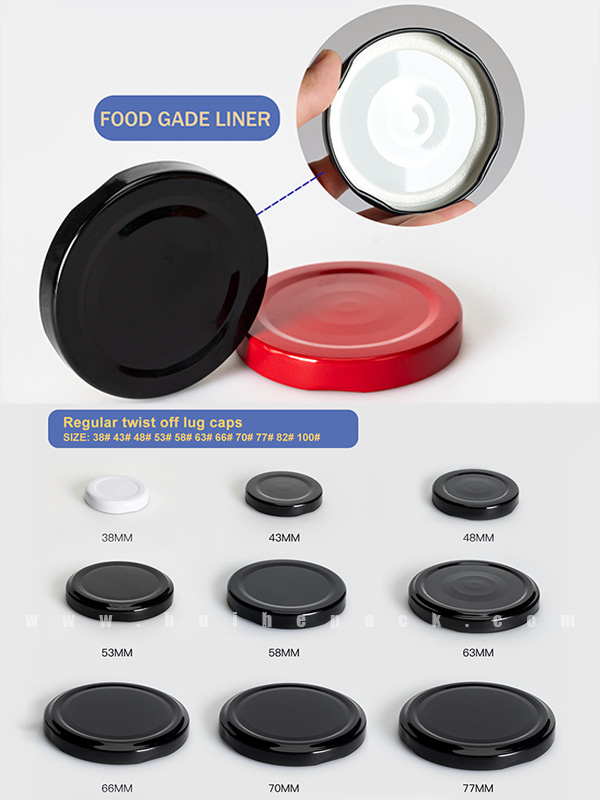
Lug caps, often called twist-off caps, engage a series of short projections on the glass finish. They generally close with a shorter turning movement than continuous-thread designs. They are familiar on many commercially packed sauces, jams and preserves, although suitability depends on the particular cap and liner specification.
These closures can be part of a validated vacuum packaging process. The packer’s equipment, product temperature, headspace and closure application all influence the result. A vacuum button, where supplied, is an indicator within that system; it is not a substitute for the producer’s complete release checks.
When evaluating a lug closure, confirm the exact finish and application method with both the closure supplier and the filler. Check opening effort after processing and storage, rather than only on empty samples. For related food applications, our glass jam packaging options show why the product and process should be considered together.
Continuous-thread screw caps: familiar and versatile
A continuous-thread closure follows a longer, continuous thread around the neck. These caps can be made from different materials and paired with different liners. They are used across dry foods, condiments and other applications, but the label “screw cap” does not identify a universal processing capability.
Some combinations suit ambient filling or dry products; others are engineered for specific thermal processes. Buyers must obtain the relevant temperature and use limits for the complete closure. Do not assume that all plastic caps are unsuitable for heat, or that all metal caps can tolerate every process.
Application and removal torque need agreed limits and an appropriate measurement method. Too little application can leave an inadequate seal; excessive application can damage components or make opening difficult. The correct settings come from the approved packaging system and line trials, not from a general torque number copied between products.
Other closure formats and where they fit
Two-piece lid-and-band systems, clip-top jars with gaskets and dispensing caps may be appropriate when their intended use matches the product. A domestic preserving format should not automatically be transferred to a commercial production line. Commercial buyers need documented compatibility, repeatable application and a validation plan for their actual process.
Clip-top designs can communicate a reusable storage identity, but gasket material, compression and wire fit require attention. Shaker and spoon-access caps improve dispensing for seasonings, while their sealing performance depends on the overcap and any separate seal. A decorative wooden or bamboo outer lid may conceal a plastic insert or gasket; assess the food-contact components rather than the visible finish alone.
| Closure family | Typical reason to consider it | Main approval question |
|---|---|---|
| Lug or twist-off cap | Short opening movement and commercial food presentation | Does this cap, liner and finish match the validated process? |
| Continuous-thread screw cap | Broad material and dispensing options | Are liner suitability and torque limits confirmed? |
| Two-piece lid and band | Preserving-style format where specified | Is the exact system approved for the intended production use? |
| Clip-top with gasket | Storage access and a distinctive reusable format | Are gasket compatibility and sealing consistency verified? |
| Dispensing closure | Controlled shaking, pouring or spoon access | Does it dispense the food while maintaining the required barrier? |
Choose the liner around food and processing conditions
The liner is often less visible than the cap, yet it is central to the seal. Specify the food’s composition, intended contact conditions, filling method, storage period and destination market. Acid, salt, oil and flavor components can affect material selection. The same outer cap can be offered with liners intended for different uses.
Ask the supplier for the exact liner reference and supporting food-contact documentation. Keep approval records tied to that reference, rather than a broad description such as “food grade.” When a liner formulation or source changes, assess whether the existing compatibility and process work remains applicable before accepting the substitution.
Some foods are packed using hot filling, pasteurization or other thermal processing; others are filled without those steps. Each route imposes different requirements. The food producer and qualified process specialist should establish the process, then confirm that the jar and closure are suitable for it. Packaging selection alone does not establish product safety or shelf life.
Separate tamper evidence from seal integrity
A tamper-evident feature helps show whether the pack has been opened or disturbed. Seal integrity concerns whether the package maintains its required containment and barrier. A shrink band can provide visible evidence of opening without correcting a poor primary seal. Conversely, a tightly fitted cap may need an additional feature to make first opening apparent.
Choose bands, membranes or closure indicators that suit the jar geometry and customer experience. Confirm that the feature remains legible and intact through distribution. Avoid describing any ordinary packaging as tamper-proof. For honey-specific handling and presentation considerations, see the honey jar closure guide.
Run filling-line and distribution trials
Trial the proposed components on the actual line or a representative setup. Include cap feeding, container handling, application consistency and inspection. Look for food on the sealing surface, cap skew, damaged finishes and variation across the production run. Record results at startup and after normal line adjustments.
Finished samples should also be assessed after the intended processing, cooling and distribution conditions. The test plan may include leakage, vacuum where applicable, opening effort, appearance and product quality. Agree acceptance criteria before the trial so that “the lid feels tight” does not become the only release standard.
If the jar body changes, revisit the relevant dimensions and handling assumptions. Our comparison of wide-mouth and narrow-mouth jars can help frame access requirements, while the closure drawing remains essential for technical matching.
What to include in a closure request for quotation
- The jar drawing, complete finish specification and representative samples.
- The food formulation category and intended contact conditions.
- The filling and processing route, with supplier-confirmed operating limits.
- The liner reference, cap material, color and decoration requirements.
- The required tamper-evident feature and opening experience.
- The line type, planned volumes and inspection requirements.
- The final carton, storage conditions and distribution test plan.
Frequently asked questions
Can a lug lid replace a screw cap?
Only if the jar finish is designed for that closure system. Similar diameter does not make lug and continuous-thread finishes interchangeable.
Does a metal lid guarantee hot-fill suitability?
No. The liner, coating, glass container and application conditions also matter. Obtain approval for the complete pack and process.
Should buyers order jars and caps together?
Coordinated sourcing can simplify compatibility checks, but it does not remove the need for drawings and trials. Where separate suppliers are used, define who is responsible for approving the assembled system.
Specify a closure that works beyond the sample stage
HUIHE PACK buyers can begin with suitable glass food jars and develop the closure specification around the product, line and market. A clear specification makes quotations easier to compare and gives production teams a consistent basis for receiving inspection and future repeat orders.
Technical reference: Fillmore Container’s commercial lid selection guidance provides additional context on why liner and processing compatibility need specific confirmation.