Glass is widely used for pickles, vinegar-based sauces, fruit preserves and other acidic foods because suitable container glass offers strong chemical durability and a useful barrier. For packaging buyers, however, the statement that glass remains stable in contact with acidic foods needs a clear boundary: it describes a material advantage, not an automatic guarantee for every container, closure or food process.
A reliable specification considers the glass body, lid, liner, food formulation and conditions of use together. This guide explains what stability means in practice and how food brands can approve glass food packaging without relying on blanket claims about safety or shelf life.
What does stability mean for food packaging glass?
Most ordinary food jars and bottles use soda-lime container glass. Its inorganic structure provides a durable contact surface and a strong barrier through the wall. These properties make glass a practical candidate when a brand wants to protect flavor and avoid a package that readily absorbs food components.
The Food Packaging Forum describes transfer of glass constituents into food as a low concern because of the material’s structure. That is a more useful technical position than claiming that no interaction can ever occur. Glass composition, surface condition, temperature, contact time and the actual food still belong in the suitability assessment.
Buyers should specify food-contact container glass for the intended application. Decorative glassware, crystal products and containers with an uncertain history are not interchangeable with an approved food-packaging article. The purchasing description should identify the supplier, item reference and supporting documentation clearly enough to trace repeat deliveries.
Why glass is a strong candidate for acidic foods
Acidic products often have distinctive aromas, colors and tastes. Glass is nonporous and does not allow oxygen or moisture to pass through an intact container wall under ordinary packaging conditions. This helps separate the food from the surrounding environment, while the closure determines whether the assembled pack maintains the required barrier.
Transparency can also serve a practical purpose. Customers can see vegetable size, sauce texture or fruit distribution, and production teams can inspect fill presentation. Clear glass does not provide universal light protection, however. If a formulation is light-sensitive, evaluate colored glass or other light-control measures through product-specific testing.
Glass manufacturer O-I describes container glass as virtually inert. The word “virtually” matters: buyers can recognize the material’s well-established packaging value while still requiring evidence for the particular food and storage conditions. Avoid turning that general property into an unqualified claim of zero migration or unlimited storage.
The lid and liner need a separate compatibility check
A jar with a glass body usually has a closure made from other materials. The food can contact the liner directly, during filling, or when the pack is tilted in distribution. Vapor and condensation can also reach the closure. An excellent glass body therefore does not eliminate the need to assess the lid and its coating or gasket.
The Food Packaging Forum specifically identifies closures as potential sources of migration and notes the influence of food composition, processing and storage. For buyers, the practical response is to request the exact closure and liner references, plus suitability information for the proposed use. A generic “food-grade lid” statement leaves too much undefined.
Ask whether the supplier has assessed the combination of acidity, salt, oil and other relevant ingredients. Do not infer compatibility from the outer cap color or from the fact that a similar product uses a similar-looking lid. Review food jar accessories as technical components, with change control for future substitutions.
Match the package to the actual food
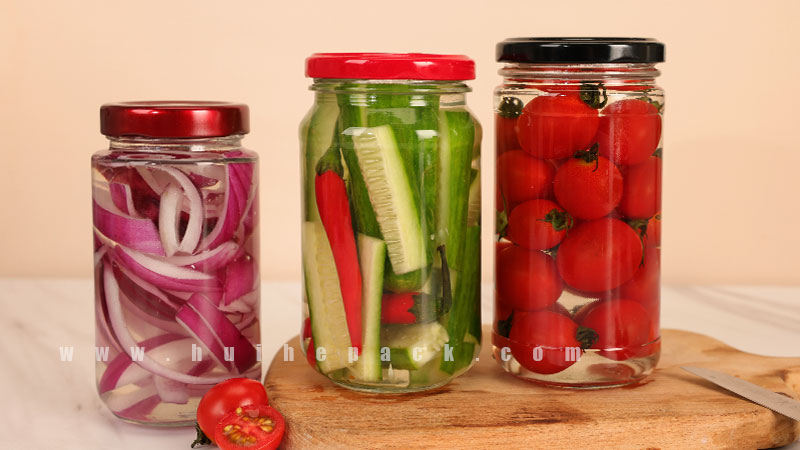
The word “acidic” covers products with very different handling needs. A thin vinegar dressing, a thick tomato sauce and whole vegetables in brine can require different filling equipment and jar openings. The formulation and physical structure of the food should guide the packaging discussion, rather than acidity alone.
| Food example | Packaging question | Useful evidence |
|---|---|---|
| Pickles and vegetables in brine | Can pieces be filled and removed without damage? | Filled samples, mouth dimensions and closure compatibility |
| Vinegar-based sauces | Does the opening provide controlled pouring? | Dispensing trials and liner suitability information |
| Fruit preserves | Does the pack suit the product’s filling and processing route? | Approved container and closure specifications |
| Oil-containing acidic dressings | Are all food-contact parts suitable for the complete formulation? | Product-specific compatibility assessment |
| Light-sensitive products | Does the presentation protect quality during display? | Storage and light-exposure trials |
For whole vegetables, our pickling jar selection guide offers additional container considerations. For pourable products, review the different sauce bottle formats before fixing a jar shape. The most attractive container is not necessarily the easiest one to fill or use.
Chemical durability is different from thermal performance
A glass container that is chemically suitable for an acidic food is not automatically approved for every heating and cooling cycle. Temperature changes introduce mechanical stresses. The jar design, glass distribution, condition and handling all matter when assessing a proposed thermal process.
Obtain the container supplier’s intended-use information and have the filler confirm compatibility with the actual process. Do not copy a heating schedule from a different jar size or assume that a heavier jar is necessarily more resistant to thermal shock. Review the closure at the same time, including any effects of processing on the liner and opening performance.
Document the approved container and closure together in the production specification. If either changes, the responsible technical team should decide what must be reassessed. This is particularly important when a purchasing substitution appears minor but alters the dimensions, seal interface or process behavior.
Acidity and glass do not establish shelf stability
Food preservation depends on the formulation and the validated manufacturing process, not simply the packaging material. A sour taste is not a release test. Producers need appropriate controls for the product, including professional assessment of processing and storage requirements where relevant.
For the United States, FDA guidance explains that commercial processors of applicable shelf-stable acidified and low-acid canned foods in hermetically sealed containers have registration and scheduled-process filing obligations. These can be specific to product, container size and processing method. A glass jar does not place the product outside that framework. Determine the applicable requirements with the responsible food-safety and regulatory team.
This distinction should also guide marketing. Statements such as “suitable glass packaging for your validated process” can be supported by a defined specification. Claims such as “acid makes every jarred food safe” or “glass guarantees a two-year shelf life” cannot be established from the container choice alone.
Plan approval trials before committing to volume
Use the real recipe and production-intent components. Evaluate the pack after filling and after representative storage and distribution. Look for leakage, closure changes, visible deterioration, product quality changes and damage to the glass finish. Agree with the relevant specialists which analytical or migration testing is needed for the market and conditions of use.
Include practical use in the trial. Check whether consumers can open and reclose the lid, remove solid pieces and pour without product collecting around the neck. Inspect labels after the expected handling conditions. These checks do not replace food-safety validation, but they help prevent a technically suitable package from becoming an inconvenient product.
Buyer checklist for acidic-food glass packaging
- Identify the food formulation and intended contact conditions.
- Specify food-contact container glass with a traceable item reference.
- Confirm the jar finish and exact matching closure.
- Obtain liner and coating suitability documentation.
- Check compatibility with the approved filling and processing route.
- Define storage, distribution and package-performance trials.
- Record acceptance criteria and responsibilities for component changes.
Frequently asked questions
Can acidic foods be packed in ordinary food jars?
Many can, when the jar and closure are approved for the food and intended conditions. The supplier and producer should confirm that suitability for the particular application.
Is the lid less important because it has a smaller contact area?
No. Its material and seal performance can still be important. Include the lid, liner and any gasket in the assessment.
Can the same jar be reused commercially?
Only within a suitable reuse system that addresses inspection, cleaning, closure replacement where needed and process validation. A reusable appearance is not evidence of an approved returnable package.
Develop a documented specification with HUIHE PACK
Start your discussion with the product, processing route and destination market. HUIHE PACK’s pickle jar formats and wider food-container range can help establish a shortlist. Approve samples as complete packs, then retain the agreed specifications for future orders.
References: Food Packaging Forum: glass food packaging; O-I: glass packaging properties; FDA: acidified and low-acid canned foods guidance.