
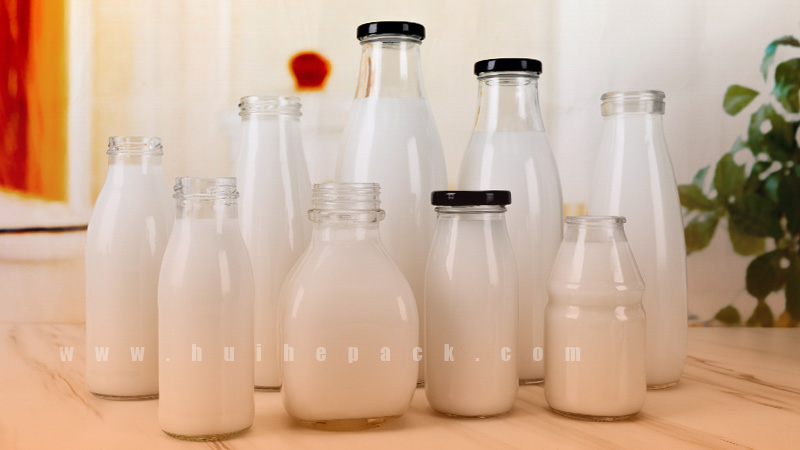
The right milk bottle size connects the way customers use your product with the way your business fills, stores and distributes it. A 250 ml bottle can suit an individual purchase, while a 1 L bottle may fit repeated household use. Between them, 500 ml can offer a different balance of portability and volume.
Those are starting points, not fixed rules. Your recipe, selling price, channel and customer habits should decide the final range. This guide compares the three capacities and shows how to evaluate cost, equipment and inventory before adding another bottle size.
Begin with the consumption occasion
Ask when, where and by whom the milk will be consumed. Is it sold as a drink with breakfast, purchased for a household refrigerator or used behind a café counter? The same product can need different sizes in different channels, but launching every size at once creates additional complexity.
Observe actual behavior where possible. Record typical order quantities, unfinished portions and requests for resealing. A larger bottle offers more product per purchase, yet it may be inconvenient for a customer who wants to finish the drink immediately. A smaller pack can improve portion fit while increasing the number of packaging components used per liter.
250 ml: consider individual consumption
A 250 ml format deserves consideration for individual drinks, tasting-oriented launches or meal combinations where the intended portion fits. It can give a new customer a lower-volume way to try a product. However, portion suitability depends on the product and audience; the bottle size itself is not a nutritional recommendation.
Check the economics carefully. Four 250 ml bottles are needed to package one liter, so there are four caps, four labels and four filling cycles per liter. The effect on cost depends on your actual bottle price, line speed and labor, but comparing only the price per bottle will hide this relationship.
Small bottles also leave less artwork space. Test mandatory copy and barcode readability at the intended label size. If a tamper-evident feature or outer multipack is needed, include it in the cost and handling assessment from the beginning.
500 ml: a flexible middle option
A 500 ml bottle may suit customers wanting more than a small single portion without committing to a full liter. It can also provide a useful starting point when a brand is testing demand across several channels. The strongest case is supported by customer behavior rather than a general claim that medium sizes sell best.
Two bottles package one liter, so the component count sits between the other options. Evaluate whether the bottle is intended to be consumed at once or resealed. That decision affects how much attention you should give to opening, pouring and storage convenience.
Compare filled samples from potential milk bottle suppliers. A tall, narrow 500 ml bottle and a shorter, wider one can feel very different in the hand and occupy different shelf space, even though the stated volume is the same.
1 L: consider repeated use and handling
A 1 L bottle may fit household consumption or a service setting where milk is used across several occasions. One bottle packages one liter, which reduces the number of caps and labels relative to the smaller formats. It does not guarantee the lowest total cost once transport, handling and losses are included.
Test pouring from a full bottle with representative users. The combined weight of milk and glass matters, as do the grip area and shoulder profile. Check refrigerator fit and whether the closure reseals conveniently after the first opening.
A larger pack may remain open longer, depending on consumption habits. Storage instructions and the producer’s validated product guidance still apply. Do not promise extra freshness because the closure can be screwed back on, and do not infer a universal after-opening life from bottle capacity.
Compare the sizes on the same basis
| Capacity | Bottles per liter | Potential fit | Main question |
|---|---|---|---|
| 250 ml | 4 | Individual drinks or trial purchases | Does the portion justify the packaging per liter? |
| 500 ml | 2 | Intermediate volume and flexible use | Will buyers finish it at once or reseal it? |
| 1 L | 1 | Repeated household or service use | Is handling convenient and turnover appropriate? |
These examples are commercial planning prompts. They do not establish demand for a specific market or define a suitable portion for every customer. Validate the proposed capacity with your own channel partners and sales data.
Calculate packaging cost per liter
Divide the complete packaging cost per filled unit by its volume in liters. If a hypothetical 250 ml pack costs 0.30 currency units for bottle, cap and label, its packaging cost is 1.20 per liter. A hypothetical 500 ml pack at 0.45 is 0.90 per liter, while a 1 L pack at 0.70 is 0.70 per liter.
These figures illustrate the calculation only; they are not supplier quotations. Add the costs relevant to your project, including cartons, freight, handling and expected losses based on evidence. For returnable packaging, use an appropriate system model that includes actual returns, washing and rejected containers rather than counting the bottle purchase only once without justification.
Then compare the result with your selling price and expected sales mix. A smaller pack may still be commercially attractive if it serves a valuable occasion. The calculation helps explain the tradeoff; it does not choose the business model for you.
Check capacity definitions before approving samples
A catalog size does not tell you the bottle’s brimful capacity, required headspace or exact fill height. Ask for the current drawing and confirm how the stated capacity is defined. Have the filling team assess the intended net quantity in the actual bottle.
Include tolerances and relevant process conditions in the approval. Avoid selecting a container merely because a hand-filled sample looks full enough. Production variation, fill control and the closure system must all work within the agreed specification.
Review line speed, changeovers and storage
Adding a size can require different guides, filling settings, capper adjustments or label setup. Ask the operator or contract packer to assess each format before placing the volume order. A trial should show whether the size can run consistently, not just whether it fits under the filling nozzle.
Compare cases and pallets using actual drawings. Smaller bottles can increase unit counts and picking work, while larger glass bottles can affect case weight. Neither effect should be assumed from volume alone. Check the packed configuration and the limits of the people and equipment handling it.
Keep the range manageable
Each size introduces another forecast, stock balance and potential shortage. If demand is uncertain, start with the capacity most closely tied to your main sales occasion, then add a second format when evidence supports it. Sharing a suitable closure across sizes can simplify purchasing, but compatibility must be confirmed for every bottle.
Review beverage closure options alongside the container range. If a standard shape cannot satisfy the operating brief, discuss custom glass bottle development with the likely volumes and changeover requirements clearly stated.
A practical size-selection checklist
- Identify the primary purchase and consumption occasion.
- Compare complete packaging cost per liter and per sale.
- Check filled weight, grip, pouring and refrigerator fit.
- Validate net quantity, headspace and closure compatibility.
- Trial the format on the intended filling and packing line.
- Forecast each size separately and test a slower-sales scenario.
Share these findings with HUIHE PACK when requesting samples. A clear size brief lets the discussion focus on appropriate bottle dimensions, compatible accessories and realistic order planning. The best capacity is the one that suits both your customer’s routine and your operation’s ability to supply it consistently.