A food brand is preparing a 250 g product launch. Its buyer finds a glass food jar described as 250 mL and assumes the two figures match. The sample arrives, but the product reaches the planned fill line before the target weight is achieved—or the target weight leaves an unexpectedly large empty area. The jar may be perfectly consistent with its specification. The problem is that volume and weight answer different questions.
Glass jar capacity describes space. Net weight describes the mass of the product inside the package. Connecting them requires information about the food, the filling conditions and the space that must remain available for closing and processing. This guide explains how buyers can turn a target pack weight into a useful glass jar specification without relying on an untested conversion chart.
Fluid Ounces and Net Weight Are Different Measurements
A fluid ounce is a unit of volume. An ounce used in a net-weight statement is a unit of mass. The NIST conversion guide gives approximately 29.57 mL per U.S. fluid ounce and 28.35 g per ounce of mass. These factors convert units within their own measurement category; they do not convert every food from volume into weight.
For example, an 8 U.S. fl oz volume is about 236.6 mL, whereas 8 oz by weight is about 226.8 g. Neither statement determines how much of your particular recipe a jar can hold at an approved filling level. On an international quotation, ask whether “oz” means fluid ounces or net-weight ounces, and identify the fluid-ounce system when relevant. Recording jar capacity in mL and product weight in g reduces avoidable ambiguity.
The empty jar and closure are packaging tare, not food net weight. A scale reading for the complete pack is gross weight. Subtract the appropriate packaging tare when evaluating the product quantity, and use your quality team’s approved measurement procedure for production control.
The Basic Relationship: Mass Equals Density Times Volume
For a reasonably uniform food, a useful planning relationship is:
Product mass (g) = product density (g/mL) × occupied product volume (mL).
To estimate the space needed for a target weight, rearrange it:
Required product volume (mL) = target product mass (g) ÷ product density (g/mL).
Use density measured for the actual formulation under defined conditions. A value taken from another brand, recipe or temperature is a screening assumption, not a production specification. Also distinguish density from viscosity: a food’s resistance to flow does not, by itself, tell you its mass per unit volume. A thick product is not automatically the densest product in your range.
The following examples demonstrate the arithmetic only. They are deliberately labeled hypothetical and are not density specifications for honey, jam, peanut butter or pickles.
| Hypothetical product | Assumed measured density | Product volume | Calculated product mass |
|---|---|---|---|
| A | 0.90 g/mL | 200 mL | 180 g |
| B | 1.10 g/mL | 200 mL | 220 g |
| C | 1.30 g/mL | 200 mL | 260 g |
All three products occupy the same volume but have different weights. Conversely, a 250 g target for hypothetical product B would require approximately 227.3 mL of product space. This is the occupied volume before checking the required headspace and the jar’s actual filling-level geometry.
Why Honey, Jam, Peanut Butter and Pickles Need Different Trials
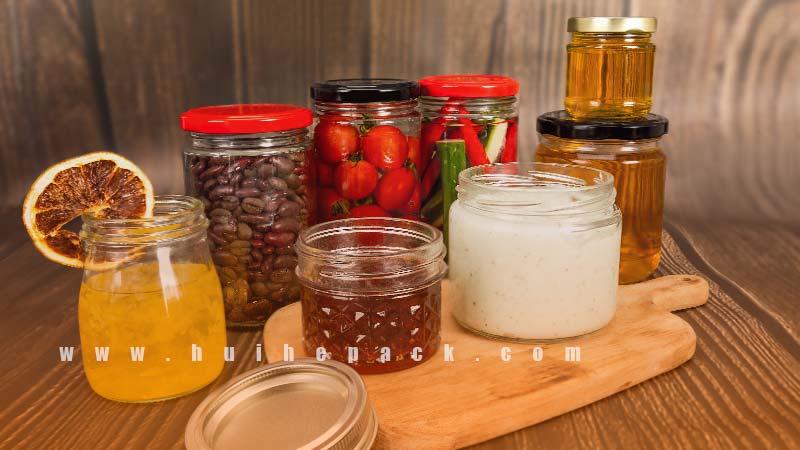
For honey jar selection, record the specific product and its filling temperature when measuring density and checking the visible fill level. A supplier’s “honey jar” name may describe a common use or commercial pack size, but it is not evidence that every honey formulation will produce the same net weight in that container. Ask for the jar’s capacity specification separately from any suggested food weight.
For glass jam packaging, use the production recipe and representative fruit-piece distribution. A smooth spread and a chunky preserve should not share a capacity assumption simply because both are sold as jam. Evaluate whether the filling process leaves pockets between pieces, whether the product settles, and how the final pack appears after the specified cooling or conditioning period.
For peanut butter, distinguish smooth and chunky recipes and reproduce the actual filling method. Product retained on a spoon or test vessel can distort a small manual trial. A countertop sample also may not reproduce the amount of entrained air or the surface profile created by a production filler. Check filled weight and headspace on representative line samples, not only a single hand-filled jar.
For pickle jars, a single uniform-density calculation is often an inadequate starting point. The size, cut and arrangement of the solids affect the space available for brine. Specify the intended solids quantity, covering liquid, packing method and fill level. Where drained weight is part of the product specification or applicable labeling requirement, evaluate it separately from total contents. Confirm market-specific labeling requirements with the responsible compliance specialist.
Full-Fill Capacity and Usable Filling Capacity
A jar’s brimful or overflow capacity describes its maximum internal volume to a defined upper reference. A commercial nominal capacity may refer to a different convention. Ask the supplier to identify exactly how each figure is measured, the reference temperature and the allowed tolerance. Do not assume two quotations use equivalent terminology.
Usable filling capacity is the product volume permitted by the selected fill level and packaging process. It must leave the space required for the closure and validated process. That requirement cannot be chosen solely to make a target weight fit. A jar with sufficient maximum volume may still be unsuitable at the approved filling level.
Headspace is also a geometry question. The same vertical distance can represent different volumes in a straight-sided jar and a jar with sloping shoulders. Avoid subtracting a guessed percentage from every catalog capacity. Ask for a drawing or measured fill-level capacity, then confirm it with samples. A photograph alone cannot establish the internal shape or usable volume accurately.
A Practical Jar Selection Workflow
Start by defining the finished product: recipe, target net weight, solids and liquid components where relevant, filling temperature, closure and intended processing method. Include the desired shelf presentation and whether the product will be sold by weight or volume in its destination market. Keep marketing assumptions separate from approved quality specifications.
Next, obtain a preliminary product-volume estimate using measured density or representative packing trials. Request candidate jars with enough documented usable capacity at the required filling level. Compare height, body diameter, opening and closure compatibility at the same time; solving the weight question should not create an equipment or labeling problem.
Then test multiple representative jar samples with the real product. Record empty packaging tare, filled gross weight, calculated net weight and the fill-line position. Document the measurement conditions and retain photographs. For products that change appearance during cooling or settling, inspect them again at the defined final evaluation point.
Finally, involve the production and quality teams before confirming a wholesale order. Validate the candidate on the intended filling and closing equipment and evaluate variation across the agreed sample plan. Set production targets and acceptance criteria through the applicable quality and net-quantity requirements; a catalog calculation is not a substitute for those controls.
What to Include in a Supplier Inquiry
Send the food type, target net weight, recipe characteristics, filling conditions, required closure, approximate order quantity and any equipment limits. Ask the supplier for the nominal and brimful capacities, capacity tolerances, dimensions and available samples. If you have a preferred fill level, mark its reference on a drawing rather than describing it only as “almost full.”
For HUIHE PACK sourcing discussions, this information helps narrow the candidate glass jars before sample approval. The final selection should be based on the actual filled package: the correct quantity of food, an appropriate closure, the approved filling space and satisfactory production performance. A jar’s volume is the starting specification; a validated pack is the purchasing decision.