Supplying mini liquor bottles for hotel minibars starts with a practical question: will the finished pack work in the guest room and in the hotel’s daily replenishment routine? A bottle can look attractive in a product photograph yet be too tall for a shelf, difficult to identify in a dim cabinet or awkward for staff to count and restock.
For glass-packaging suppliers, spirit brands and hospitality distributors, the best specification connects presentation with operations. This guide focuses on the empty bottle and finished packaging system, from capacity and closure selection to carton design and repeat-order consistency. Start by comparing appropriate wholesale mini liquor bottle formats, then validate them with the actual hotel setup.
Clarify the supply scope before choosing a bottle
Identify whether the project is for empty glass containers, filled branded bottles or a private-label packaging program. These are different deliverables. The glass supplier should not assume responsibility for filling, beverage approvals or hotel distribution unless those services are specifically included in the agreement.
Ask the customer which party approves the bottle, closure, artwork and final filled sample. In a hotel program, a procurement team may prioritize availability while the beverage brand controls visual identity and the filling partner controls technical compatibility. Naming the decision owners early prevents an attractive sample from reaching production before the required checks are complete.
Match capacity to the minibar program
Miniature bottles are available in several capacities, with 50 ml and 100 ml among the formats buyers may compare. The appropriate choice depends on the customer’s assortment, intended presentation and destination requirements. There is no single capacity that fits every hotel or every market.
Confirm the declared fill volume separately from the container’s brimful capacity. The filler needs an appropriate working fill and headspace, while the hotel needs a consistent product format. A change in capacity may also change the label area, closure size and carton configuration. For a focused comparison, see our 50 ml versus 100 ml liquor bottle guide.
Measure the finished bottle in the actual cabinet
Use the maximum assembled height, width and depth, including the closure and any tamper-evident feature. Nominal capacity says little about how a bottle fits a door shelf or display tray. Two 50 ml designs can have very different footprints because of their shoulder shape, base thickness and neck length.
Request photographs and measurements of the intended minibar layout, then test physical samples in representative units. Check door clearance, shelf lips and removal space. If a property uses an automated minibar system, have its operator confirm that the bottle and placement work with that system rather than assuming a standard format is compatible.
Assess stability with the bottle full and nearly empty. A very tall, narrow profile may need more support during transport and display. A broad bottle may be stable but occupy space reserved for neighboring products. The best compromise is established in the cabinet, not on a drawing alone.
Choose a closure that supports clear first opening
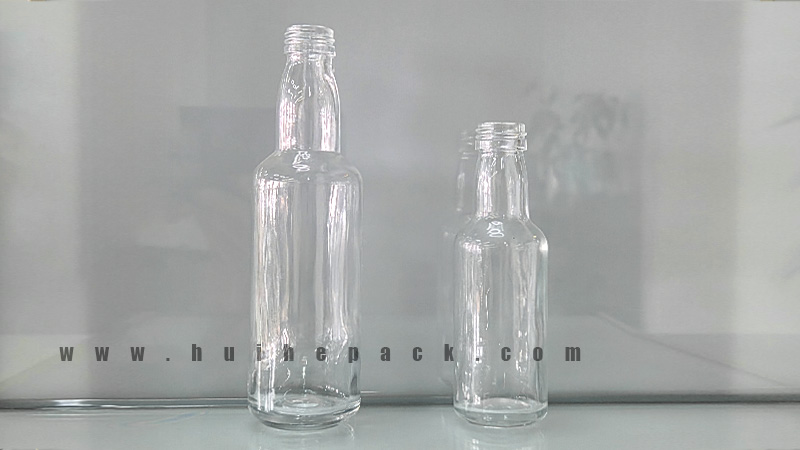
Closures should match the glass finish and the filling partner’s equipment. Pre-threaded screw caps, suitable roll-on closures and stopper formats involve different application methods. A closure chosen for its appearance can create problems if the capper cannot apply it consistently to the miniature format.
Ask how first opening will be visible and how staff should handle a disturbed pack. A tamper-evident band or closure feature helps make opening apparent; it does not replace seal-integrity checks. Avoid describing a bottle as tamper-proof. Guests should be able to recognize the intended opening method without struggling with small, sharp or poorly positioned components.
Test leakage and opening effort using production-intent samples. Confirm the liner or stopper’s compatibility with the actual beverage, including any formulation characteristics beyond alcohol content. Our comparison of liquor corks and screw caps can help frame the discussion, while the final specification must remain product-specific.
Keep miniature labels readable
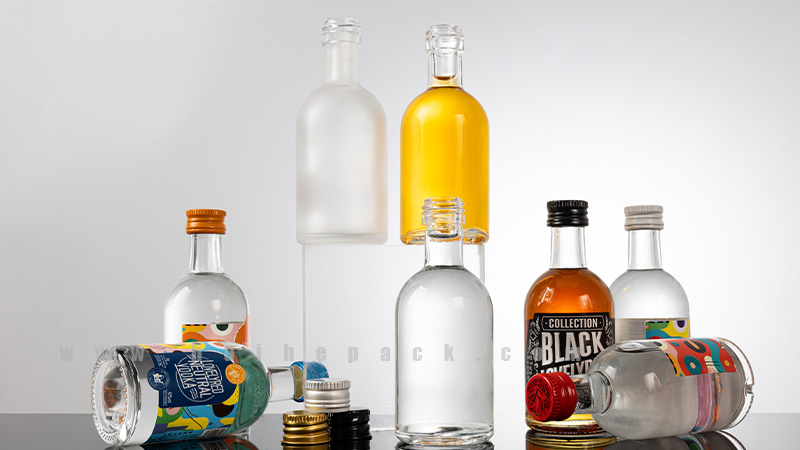
A small bottle has limited artwork space, so establish the usable label panel before design begins. Measure the straight body area and keep important information away from sharp curves or seams. Test the design on a real filled bottle rather than approving an enlarged screen image.
The beverage brand should confirm the mandatory information for each destination market. A compact package is not a reason to assume labeling obligations disappear. Where multilingual artwork or additional market information is needed, review the layout early with the responsible compliance team and filling partner.
For everyday hotel operations, make product identity easy to distinguish across the assortment. Staff should be able to tell similar variants apart without reading tiny decorative text. Check contrast in the actual minibar lighting and inspect labels after handling and any expected condensation. Batch identification should remain legible through storage and delivery.
Design cases for receiving, counting and restocking
Hotels often move stock through several handling stages before it reaches a guest room. Ask how cases are received, where they are stored and how bottles reach housekeeping carts. A protective shipper should support that workflow without making routine counting unnecessarily slow.
Specify case quantity, dividers or other separation, case markings and the agreed pallet arrangement. Distinguish the packaging used to ship empty glass to a filler from the case used to deliver finished bottles to the hotel. Each has a different job and may require separate approval.
Distribution tests should use the final filled pack and closure. Inspect for leakage, glass-to-glass contact, cap damage and label scuffing. For more detailed transport considerations, review preventing leakage when shipping mini liquor bottles. A carton that protects the glass but rubs away essential coding is not a successful final pack.
Build replenishment around realistic demand
Request forecasts by property or distribution region, including seasonal changes and planned launch dates. Separate the first order from the expected repeat order pattern. A custom decorated bottle may require different planning from a standard stock design, especially when multiple labels share one glass body.
Agree lead-time definitions: production completion, dispatch and delivery are different milestones. Confirm minimum order quantities for glass, closures, decoration and cartons separately. A component with a higher minimum than the bottle can determine the practical order size.
Retain approved samples and specification revisions so repeat deliveries remain consistent. If a supplier proposes a substitute cap or bottle, compare dimensions, line performance and appearance before acceptance. The hotel’s existing cabinet layout makes apparently small design changes operationally important.
Compare total packaging cost
Evaluate the full delivered packaging system rather than the empty-glass price alone. Include closures, decoration, protective materials, freight assumptions, inspection and the handling consequences of the chosen case format. A heavier bottle can create a premium impression, but its cost and logistics effects should be visible in the comparison.
| Decision | What the supplier should provide | Who should approve it |
|---|---|---|
| Bottle dimensions | Drawing and assembled samples | Hotel operator and packaging buyer |
| Closure system | Finish match and application specification | Brand and filling partner |
| Artwork | Actual-size decorated sample | Brand and market compliance team |
| Shipping case | Packed sample and handling plan | Distributor and hotel receiving team |
| Repeat supply | Lead times and component change procedure | Procurement and supplier |
Frequently asked questions
Is 50 ml always the best minibar size?
No. It is a useful format to consider, but cabinet fit, the customer’s program and market requirements determine the appropriate capacity.
Should hotels choose custom bottle shapes?
A custom shape may support the brand, but confirm filling compatibility, cabinet fit and replenishment economics first. A standard bottle with carefully designed decoration may meet the brief more efficiently.
Can a packaging supplier guarantee no leakage?
Leak performance depends on the bottle, closure, application and distribution conditions. Agree measurable acceptance criteria and validate the assembled pack rather than relying on an absolute promise.
Prepare your hotel bottle brief for HUIHE PACK
Share the desired capacity, minibar dimensions, closure preference, artwork requirements, destination and forecast quantities. HUIHE PACK can use that brief to discuss suitable mini glass bottle options. Approving the complete sample with the filler and hotel team creates a clearer route from design to repeat supply.