
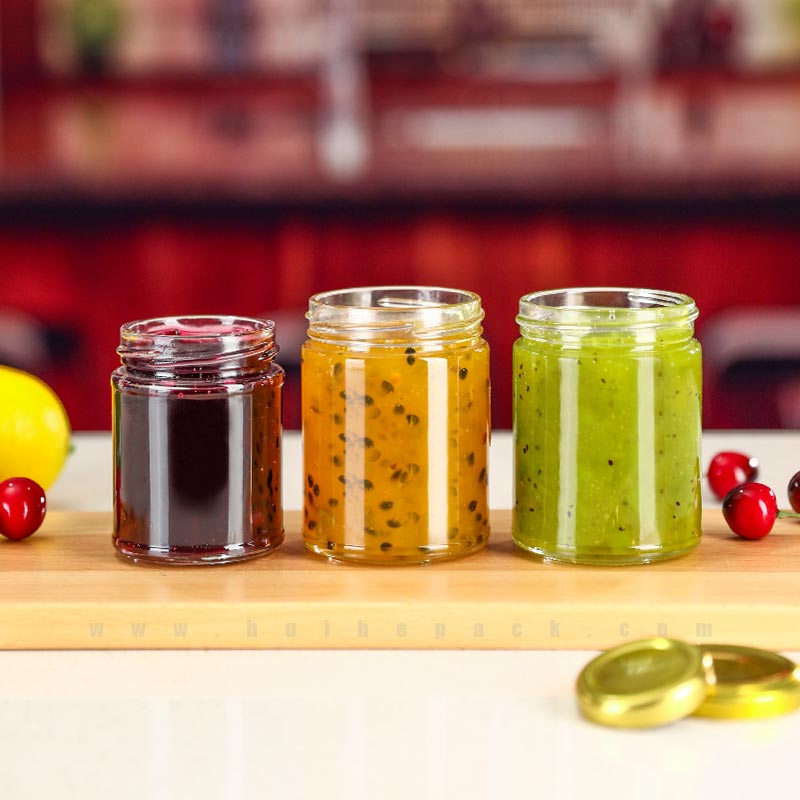
A jar that looks right in a product photo may be awkward on a filling line or difficult for customers to empty. If you are choosing glass food jars for a new range, start with the food and the filling process. Then narrow down the capacity, mouth, shape, and lid. This approach helps you compare samples on the factors that affect daily production and the finished pack.
This guide covers five common product groups: jam, honey, sauces, spices, and preserves. The recommendations are starting points for commercial packaging. Your food safety team and filling partner should confirm the final jar and closure combination under your actual process.
Start with the product and its filling process
Before browsing shapes, write a short packaging brief. Is your product thick, pourable, or made with whole pieces? Will you fill it cold, hot, or under another validated process? Does it need refrigeration, or are you developing a shelf-stable product? How will people use it: spoon, dip, shake, or pour?
These answers set the practical limits. A thick fruit spread needs enough mouth clearance for clean filling and spoon access. A dry spice blend needs a closure that suits shaking or measuring. A pourable sauce may work better in a bottle than a jar. Acid level, water activity, processing temperature, and intended shelf life also affect the package validation plan. Do not assume that glass alone makes a product shelf-stable.
Ask your supplier for jar drawings, capacity and overflow specifications, neck finish details, closure samples, and any relevant food-contact documents. Share the same information with your filling team so they can test the complete pack, rather than the empty jar in isolation.
Match the jar to what you sell
Jam and fruit spreads
For jam, jelly, marmalade, and fruit spreads, a straight-sided or gently tapered jar is easy to label and easy to scoop. Small gift or sampling formats can sit beside a larger everyday size. A wide opening helps with thick or chunky recipes and keeps the rim easier to clean before capping. If the jam is hot-filled or otherwise thermally processed, verify the jar, lid, liner, and process together.
Our glass jam packaging solutions page shows options for brands comparing retail and gift formats. If you are also weighing jar shapes for shelf display, see how jar shape can influence food sales.
Honey
Honey flows differently as temperature and variety change. A round jar is a versatile choice for a broad product line; a hexagonal jar can help a specialty or gift range stand out. Check that the mouth allows neat filling and that the neck and lid seal reliably after handling. For honey with comb or other inclusions, allow enough access to place and remove the contents without damage.
Capacity can be confusing because jar volume in milliliters and the net weight of honey in grams are different measurements. Fill trials should establish your actual net weight, headspace, and label declaration. Explore our honey jar size guide for format planning, and compare honey jar closures once you have a shortlist of neck finishes.
Sauces and condiments
Think about how the customer will serve the sauce. A thick chutney, salsa, paste, or spoonable condiment can work well in a wide-mouth glass jar. For a thin hot sauce or pourable dressing, a narrow-neck bottle often gives better control. Pieces of vegetables or herbs make a wider opening more useful. A jar with a flat label panel gives you space for ingredients and branding.
Do a fill and dispensing test with the real recipe. Check drips on the rim, product left in the shoulders, and the opening force after processing. If you are comparing bottle formats as well, the sauce bottle size guide and sauce bottle range help you decide when a bottle suits the product better.
Spices and dry blends
For whole spices, loose herbs, and dry blends, decide whether customers will spoon, pour, or shake. A small, straight-sided jar provides a clean label area and efficient shelf layout. Pair it with a compatible shaker fitment when controlled dispensing matters, or a simple lined cap for spoon access. Test the fitment with the actual particle size: a fine powder and a whole peppercorn will not dispense the same way.
Protect the product from moisture during filling and storage. The seal, liner, and any induction-seal component must be selected for the intended distribution conditions. If your range needs controlled dispensing, compare bulk spice shakers and the jar alternatives before locking in a format.
Preserves and pickled products
Whole fruit, pickles, and vegetables need room to pass through the opening without bruising or slowing the filling line. A wide-mouth jar also makes it easier for customers to reach the last piece. Round or ergo-style jars are useful candidates for larger pieces and family-size packs; shape selection should still be checked against label application and case packing.
Preservation method is the deciding factor. A decorative jar or a jar sold for dry food is not automatically suitable for heat processing. Confirm thermal-shock performance, closure compatibility, vacuum targets, and the approved process with your processor. Read our wide-mouth versus narrow-mouth jar comparison for a closer look at filling and use.
Choose capacity by the finished pack, not the catalog number
Jar capacity is generally stated as a volume, while many foods are sold by net weight. A 250 ml jar does not promise 250 g of jam, honey, or spice. Density, solids, pieces, fill temperature, and required headspace all affect the weight you can declare. Start with your target net weight and run a real fill trial before selecting the nominal jar size.
As a planning shortlist, small jars suit samples, gifting, and premium portions; mid-size jars suit many everyday spreads and condiments; larger jars suit family or foodservice packs. Common food-jar catalog sizes include 250, 370, 500, 720, and 1,000 ml, but availability depends on the shape and neck finish. Compare filled weight, shelf height, shipping cases, and price per filled unit across two or three samples. Do not order based on nominal capacity alone.
Decide between a wide mouth and a narrower opening
A wide mouth can speed the filling of thick foods and whole pieces. It also helps people spoon out every serving. The trade-offs can include a larger lid, more exposed product at opening, and different packing density. A narrower opening may suit pourable foods, smaller closures, and controlled dispensing, but can make chunky products harder to fill and remove.
Put a jar on your filling line before making the decision. Measure spillage, fill speed, capping performance, and customer access. Check that the filling nozzle clears the opening and that the labeler can handle the body shape. The best opening is the one that works across production, shipping, and use.
Treat the lid as part of the package
The lid has to match the jar’s exact neck finish, not just a similar-looking diameter. Thread or lug design, sealing surface, liner compound, cap height, and application torque all matter. A metal twist-off or lug lid may be appropriate for some processed foods when specified and validated for the process. Continuous-thread closures and dispensing fitments serve other use cases. Ask for a matched jar-and-lid sample set, not separate untested components.
Run closure trials using your actual product and line settings. Check torque, leakage, vacuum or seal integrity where applicable, opening effort, and performance after transport and storage. Tamper-evident features can support consumer confidence, but their use and design depend on your market and process. Our food jar accessories page is a starting point for matching lids and other components.
Check appearance against production and distribution
Clear flint glass shows the color and texture of jam, honey, and pickles. Amber or other colored glass may suit a particular design brief, but do not rely on glass color alone for a shelf-life claim. Straight walls make labels easier to apply; hexagonal and embossed shapes offer stronger visual identity but need more careful label and case planning. Decoration, frosting, and printing should be tested for scuffing and handling on the intended route to market.
Ask for a filled sample, not only an empty showroom sample. Check the jar under store lighting, inside its shipping carton, and after a simulated handling trial. If you expect ecommerce or export shipping, review dividers, pallet pattern, gross case weight, and breakage risk with your logistics team. A striking jar has little value if its label wrinkles or too many units arrive damaged.
Use a sample checklist before ordering in bulk
Request two or three jar-and-closure combinations and test each one with the same recipe. Record the nominal and overflow capacities; actual net fill weight; mouth clearance; headspace; capping torque; leakage or seal checks; label fit; packed case dimensions; and damage after distribution testing. Keep the approved drawing and sample as your production reference.
For heat-treated or shelf-stable foods, have a qualified process authority or your food safety team validate the product, process, container, and closure for the target market. Commercial jar selection and home canning advice are different: do not substitute a standard decorative or commercial jar for a tested home-canning jar in a home-canning recipe.
When you have a target capacity, neck finish, closure type, annual volume, and decoration plan, browse our food jar range or send HUIHE PACK your packaging brief. We can help you compare stock and custom glass jar options, matching closures, and decoration samples before you commit to a production run.